MATERIALS SCIENCE RESEARCH · JULY 2024 – PRESENT
A coffee pod that dissolves once its job is done.
Three years of research on sustainable food packaging: patent pending, published in a peer-reviewed journal, and now continuing inside a Rutgers University laboratory.
01 · The problem
Why pods can’t be recycled
A coffee capsule is a laminate: a plastic or aluminum cup, a barrier layer and an aluminum lid, bonded so tightly they can never be separated again. That bond keeps the coffee fresh, and it is exactly why the pod cannot be recycled in standard facilities. Billions end up in landfill every year.
So the question was not how to make the laminate more recyclable. It was whether the shell could be a single natural material that holds its shape against hot water and pressure for the length of a brew, then simply stops existing, the way bioabsorbable surgical implants disappear once their job is done.
02 · Our approach
How we tried to solve it
My co-founder and I had no laboratory. We ordered biopolymers online and cast films on a kitchen counter, working through the problem in five stages.
-
01
Literature review
A meta-analysis of 50+ research papers on biodegradable and water-soluble packaging materials.
-
02
Material screening
Nine candidate biopolymers tested against six criteria: heat resistance, pressure tolerance, barrier strength, dissolvability, food safety and cost.
-
03
Pullulan
The winner: a natural, water-soluble polymer produced by fermentation, strong enough to hold a brew and fully biodegradable afterwards.
-
04
200+ prototypes
Formulation after formulation, iterated on thickness, plasticizer and moulding until one held.
-
05
Into the lab
Validated and extended in the Food Science laboratory at Rutgers, with a focus on shelf life, sustainability and commercialization.
03 · Failure first
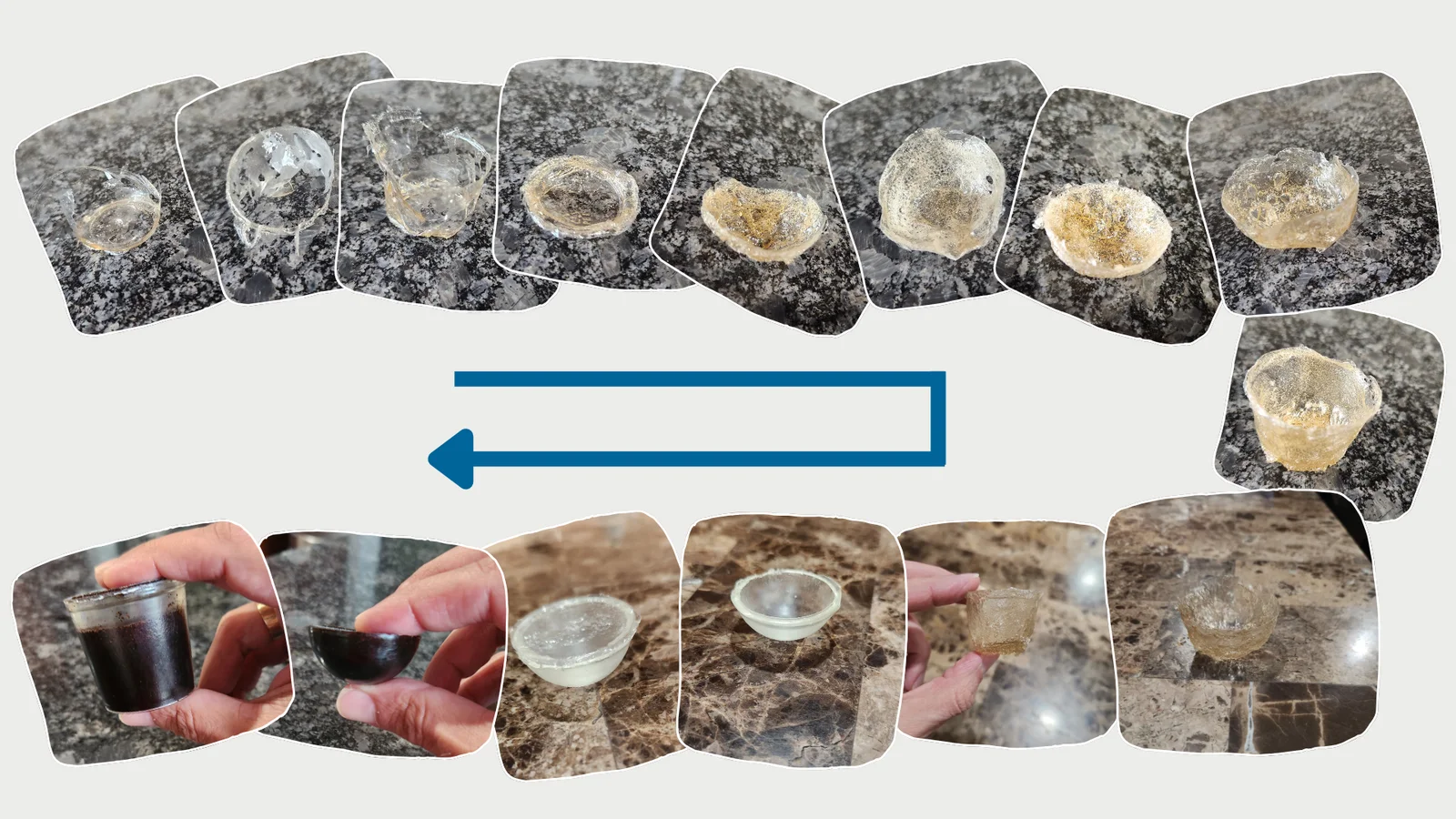
200+ prototypes that didn’t work
Most of the first two years were failure. Pods tore, dissolved too early, cracked or wouldn’t hold coffee. Every one of them taught us something, and one formulation finally held.
04 · The record
Where the work stands
-
Paper
Peer-reviewed publication
Future Scholars Journal, 2026 · DOI 10.61340/fsj.2026.08 · Also on ResearchGate
-
Patent
Intellectual property
US provisional patent application 64/119,414 filed; utility patent pending on the dissolvable pullulan film.
-
Lab
Laboratory
After 40+ cold emails and presentation of the independent research got me an invitation to join related lab research on commercialization, sustainability and translational aspects of the innovation that helped Naturista improve its product line. I co-wrote the lab's commercialization plan submitted to the USDA.
-
Venture
Commercialized as Naturista
A dissolvable coffee pod, available to buy from the website and a machine brew coffee pods on its way!
05 · Recognition